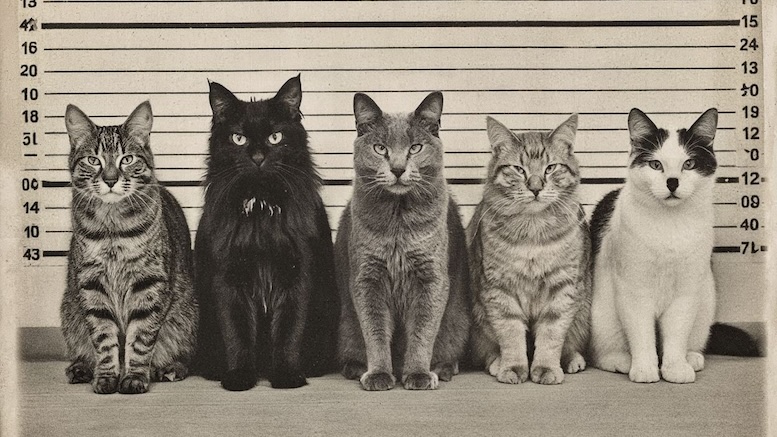

Law360 reports that the Fourth Circuit has affirmed the conviction of a man who illegally accessed and leaked the private health information of former Justice Ruth Bader Ginsburg. In United States v. Russell, the court held it was not an abuse of discretion to deny Russell’s motion to exclude statements he made to federal agents during an interview.
Those statements included Russell’s attempt to blame his cat for the incriminating search term, “gins,” which Russell suggested his cat had typed by running across his keyboard.
Before her death in 2020, Justice Ginsburg was being treated at George Washington University Hospital. In January 2019, someone posted information about her treatment on 4Chan, where, the opinion says, users were “promot[ing] a conspiracy theory that Justice Ginsburg had [already] died and prominent Democrats were covering up her death.” (Presumably the motive would have been to prevent then-President Bozo Waffles from replacing Ginsburg. I would have supported that, but the idea that “prominent Democrats” would have been competent enough to pull it off is almost as comical as the cat-blaming.) The information then spread to Twitter.
Wrongfully obtaining and disclosing such information is a federal crime (well, two crimes), and an investigation followed. Not surprisingly, this focused on hospital employees and contractors who had access to the hospital’s computer system. Should a hospital employee or contractor with access to the system have foreseen this? Probably. But at least two did not.
Hospital officials looked at the search logs to see if anyone not involved with Ginsburg’s treatment had searched for a name starting with “ginsb” during the relevant period. They found that an ER employee had searched for “ginsbur,” but decided it was unlikely he had been the leaker (he was fired, but not prosecuted). So they kept looking.
This led them to Russell, a contractor working as a transplant coordinator. On January 7, 2019, three searches were run using Russell’s credentials: “gins,” “barker,” and “ginston.” There was a patient named “Barker,” but no “Gins” or “Ginston.” But there was, of course, a patient named “Ginsburg.” This was enough for a visit from federal agents. Also a visit from Russell’s boss, who decided she wanted to sit in on the interview. So she was present for the lies Russell was about to tell.
Russell admitted that whoever ran the searches had been logged in as him. He also admitted he had searched for “barker,” which he might have had a legitimate reason to do. But he denied searching for “gins” or “ginston.” Hm. So who might have run those searches while logged in as him, immediately before and after a search he admitted he did run?
He didn’t know, he told the agents, but he had a couple of theories.
The first was that “a coworker may have used his login information” to run the other two searches. He was being framed! Probably not, though, because the agents knew the three searches had been run within a matter of seconds. (Prosecutors argued Russell realized, correctly but too late, that “gins” might look suspicious, so he followed that with a fake but plausible search and then a search for a made-up name also starting with “gins,” hoping to cover his tracks.)
But the second theory is why we’re here: Russell suggested that “potentially his cat had run across the keyboard and typed in those letters.”
It is, of course, statistically true that if an infinite number of cats ran across an infinite number of keyboards, sooner or later one of them would type the name of a U.S. Supreme Court justice. And—to my surprise—it is possible that even a finite number of cats and keyboards might accomplish this during the estimated lifespan of the universe. See Stephen Woodcock and Jay Falletta, “A numerical evaluation of the Finite Monkeys Theorem,” 9 Franklin Open Journal (Oct. 30, 2024).
Woodstock and Falletta found that, even if 200,000 monkeys had 200,000 keyboards, it would be effectively impossible for them to produce the complete works of Shakespeare (the usual goal in this thought experiment) before the universe comes to an end. Id.; see also “Monkeys will never type Shakespeare, study finds,” BBC News (Oct. 31, 2024). But towards the other end of the scale, there was a non-zero chance—about 5%, in fact—that just one monkey would produce one particular word (“bananas”) during its estimated lifespan. (I know—for some reason they start talking about chimps, which aren’t monkeys. Email them, not me. We’ve been over that. See “Clarification: Monkey v. Ape,” Lowering the Bar (Oct. 20, 2008)).
So I conclude it wasn’t impossible that during its lifetime, Russell’s cat could have randomly typed the name of a U.S. Supreme Court justice, even Justice Ginsburg in particular. A fortiori, it could have typed the shorter terms “gins” or “Ginston” during that time. Sadly, Russell didn’t have the benefit of this research in 2019. But it wouldn’t have helped anyway. Even accepting the above, the probability the cat would have typed both terms within a mere matter of seconds (pausing to let Russell search for “Barker”) would surely be effectively zero.
As you’ve probably guessed, this wasn’t the only problem with Russell’s story. When agents asked to see his work computer, he said it had been stolen. (Also not impossible!) But he did turned over a hard drive from his home computer, and even though he had tried to wipe it, the government recovered enough information to indict him. (Destroying evidence became his third charge.)
What, you want (another) legal issue? Fine. The main issue on appeal was whether the district court should have excluded what Russell said during the interview and thus also the hard drive. Russell argued the statements were “involuntary,” not because he was beaten or anything but because his company’s CEO was there. But the agents didn’t invite her—she just decided to sit in—and the court held the circumstances didn’t establish coercion. Russell volunteered his very unlikely story.
Of course, given enough judges and enough opportunities, it’s not impossible Russell might convince one with arguments like these. It’s just not likely to happen during the estimated lifespan of the universe.
<